


Summer is almost over, which means back-to-school season is right around the corner.
Parents are starting to shop, students are getting ready for a new school year, teachers are preparing for the year ahead... and everyone's getting ready for this new year!
Back to School is a prime season for retailers and eCommerce businesses (and of course, not only regular school supplies, all the way to electronics, apparel, footwear, and more).
It's one of the best times for retailers and eCommerce businesses to connect with shoppers.
During this season, people are buying all kinds of products, from school supplies and clothes to gadgets, shoes, and more.
That’s why it’s important to plan email campaigns that match what your customers are looking for and help your brand stand out during the busy shopping season.
For businesses, this is a natural opportunity to connect with customers who are already thinking about what they need for the months ahead.
But instead of sending one random “Back to School!” promotion, it helps to plan your emails around the different stages of the season.
That’s where a back-to-school email marketing calendar comes in.
Instead of figuring out what to send at the last minute, you can plan your emails around each stage of the season.
The Raging Back to School Market: Why Should You Care?
Back-to-school is one of those seasonal moments when customers already have a reason to shop.
It's a spending season, and you don’t have to sell traditional school supplies to join the conversation.
A fashion brand can promote a new-season collection. A tech brand can showcase study essentials. A food business can share easy lunch ideas. A wellness brand can talk about getting back into a routine.
Back to school spending per household in the United States was already increasing over the preceding two years and is now above $1,000.
Further, it’s critical to note that it’s not just adults who do the shopping. On an average, the average teenager in the United States spent $60 of their own money on back to school goods.
Because of these rising prices, families are now more careful when shopping. Many also get ideas from social media like Instagram and TikTok when deciding what to buy.
For businesses, this is important. It means people are looking for good deals. If your emails are clear, helpful, and well-timed, you have a better chance of getting their attention and increasing sales during this season.
What Products Are Part of Back to School?
The product categories are many, but some of the most popular ones are as follows:
Back-to-school shopping covers a lot of products, but the most common ones are:
- School supplies (notebooks, pens, backpacks)
- Clothing and uniforms
- Shoes and sneakers
- Electronics (laptops, tablets, accessories)
- Lunch boxes and water bottles
So yes, the Back to School season is important for you, because it matters to your audience.
Let’s look at some inspiration for email marketing campaigns, examples of back-to-school promotions, and more.
Even if your eCommerce business has nothing to do with any of the back-to-school products or product categories, the examples and email marketing campaign ideas are invaluable.
Start Planning First
Before you start creating emails, it’s important to plan ahead. This helps you stay organized and consistent during the busy back-to-school season.
Start by building an email calendar or an inspiration list. This will make it easier for you to map out what emails to send, when to send them, and what message each one should focus on.
To make this process easier, you can use a tool like Panoramata. Sign up, then create a new list in your dashboard (you’ll find this option on the left side panel). From there, you can start collecting ideas for your campaigns.
Use the search feature to look for back-to-school email campaigns.
Explore different brands and see how they structure their emails, what offers they use, and how they design their layouts.
As you browse, save the emails that stand out to you.
Focus on things like strong subject lines, clear discounts, simple designs, and effective calls-to-action.
You should also look for patterns across top-performing campaigns.
Notice what many brands are doing the same way, this often shows what actually works.
Think of this process as collecting “what works” so you can build your own version later, but in a way that fits your brand and audience.
Email is also useful because you can do more than announce a sale. You can share a checklist, introduce a collection, offer helpful tips, or send a timely reminder when the first day gets closer.
That’s why having a calendar can make such a difference. Instead of sending the same type of promotional email throughout the season, you can give each message a different purpose.
When should you start your back-to-school email campaign?
There’s no universal back-to-school date.
In the U.S., Canada, the UK, and much of Europe, schools generally start returning from mid August into September. In Australia and New Zealand, the main back-to-school period generally begins in January.
As a general rule, start planning four to six weeks before school begins - mid August is a good time to start.
And if you're not taking advantage of the season... your competitors will!
Mid August gives you enough time to move through the different stages of the campaign: Plan → Shop → Prepare → Act → Settle in
Your early emails can focus on planning and inspiration.
As the first day gets closer, you can move toward products, promotions, and deadlines.
Once it really starts, your content can shift toward helpful tips and resources.
What should you include in your emails?
You don’t need every email to be a sale.
In fact, mixing promotional emails with useful content can make your campaign feel much more natural.
Checklists and shopping guides
Back-to-school shopping can get overwhelming, so help your audience organize what they need.
Try:
- First-day checklists
- Work/Study setup guides
- Lunchbox essentials
New products and collections
The new school year is a natural time to introduce new products or seasonal collections.
Keep the selection focused instead of showing your entire catalog. One hero product and a few supporting products are usually easier to browse.
Offers and bundles
Customers are often buying several things at once, so bundles and multibuy offers can make sense.
You could promote:
- 3-for-2 offers
- Bundles
- Student discounts
- Teacher discounts
- Free shipping
- Limited-time promotions
- Just make the terms clear and easy to find.
Tips and lifestyle content
You can also use your emails to help customers prepare for the new routine.
For example:
- A tech brand could share a study setup guide.
- A food business could share easy school lunch ideas.
- A wellness brand could share tips for getting back into a morning routine.
- A home brand could share dorm organization tips, or refresher advices.
The goal is to give people something useful while naturally connecting it to your products or expertise.
Back To School Marketing Campaigns Ideas
Casper - Classic Sales

Take a look at this back-to-school campaign from Casper Mattresses.
What we love about this campaign:
- Showing an image of a real person using the actual product is always a smart idea. The next best thing to actually “feeling” the mattresses (as you’d in a physical store).
- Short copy format is punchy, subtle, and has a direct offer.
- The headline with “...still going” subconsciously tells the reader that it could “end” soon. Fear of missing out (FOMO), anyone?
- Use "still going" rather than a countdown when you do not have a real deadline. It creates urgency without inventing scarcity.
The Sill - A Sales with Context

The back-to-school campaign for The Sill doesn’t waste any time nor does it make you guess. The instant you open the email campaign, you know what it’s for, what the offer is, and more.
What we love about this campaign:
- The “no nonsense” direct offer (15% off)
- Copy that helps add more context to the offer just made (above). 15% off your favorite plants and accessories.
- State the offer in the first line and use the second line only to say what it applies to. Works when your audience already knows the brand.
Schoolyard Snacks - Tiered Discounts
Schoolyard Snacks stands out because it doesn’t feel like a typical promotional email. Instead of sounding formal or sales-heavy, it talks to you in a casual, human way that feels more like a friend sending a message than a brand pushing a product.
Right away, the subject line pulls you in: “Graduate your snacking with our Buy More, Save More sale.” It’s playful, a bit unexpected, and it immediately sets a fun tone before you even see the offer.
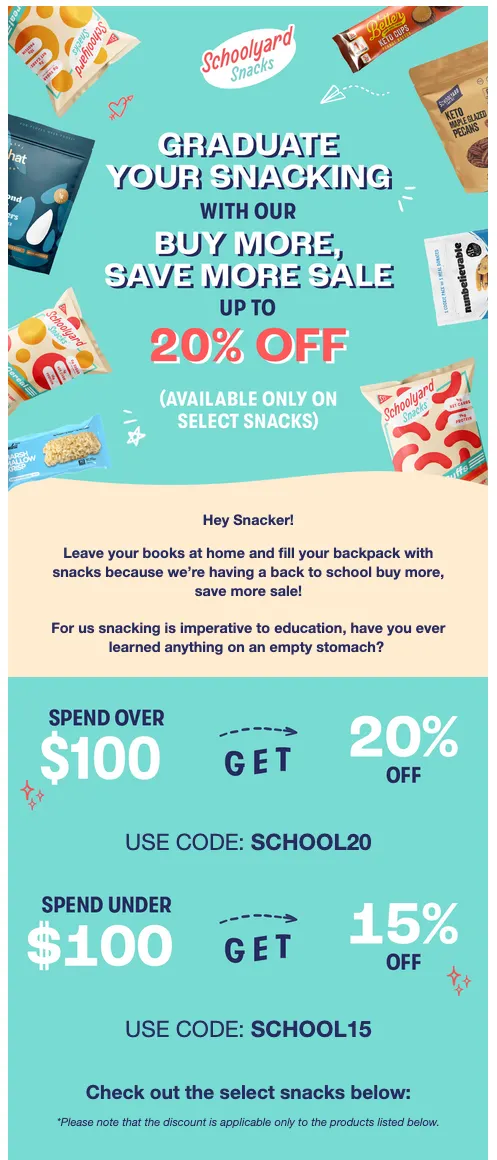
Then the email keeps that energy going with lines like “Hey snacker!” and “Have you ever learned anything on an empty stomach?” This kind of humor works because it connects to a real student feeling, being hungry while studying, and turns it into something relatable instead of just another discount announcement.
The structure of the offer is also very intentional. Instead of one flat discount, they use a tiered system:
- Spend over $100 → 20% off (code: SCHOOL20)
- Spend under $100 → 15% off (code: SCHOOL15)
This is not just about giving a discount. It’s designed to influence behavior. The higher tier naturally encourages people to add more items to their cart just to “reach the next level.” At the same time, the lower tier still feels rewarding, so no one feels left out.
They also make sure to clarify that the discount only applies to selected products. This is important because it manages expectations early and prevents frustration at checkout.
Clinique - Gamify your emails
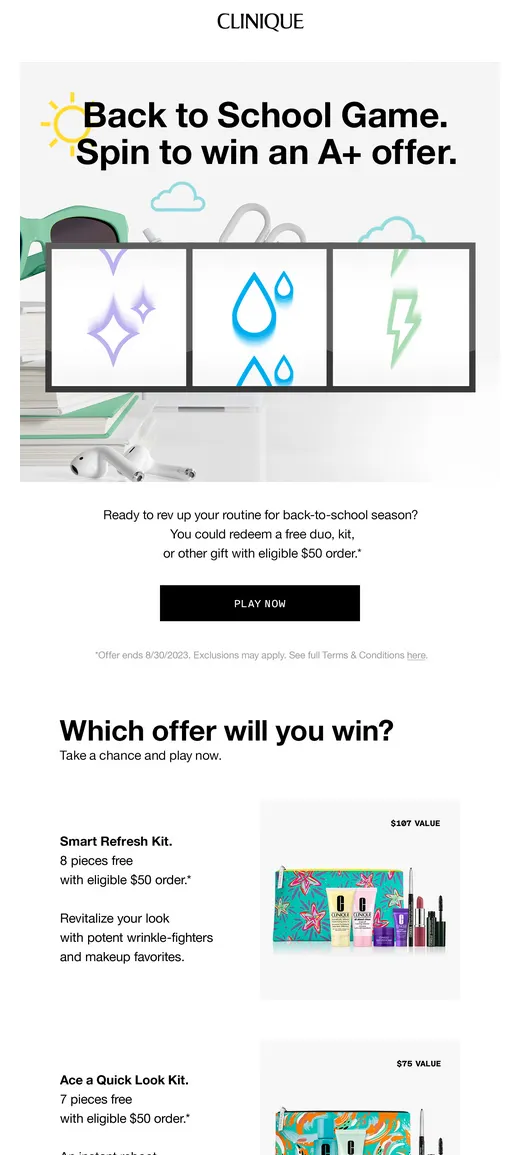
Clinique does something a little different here. Instead of just sending you a normal discount email, they turn the whole thing into a game.
Right away, the subject line “Back to School Game: Spin to Win an A+ Offer” already makes you curious. It doesn’t feel like a typical promo. It feels like you’re being invited to play something, not just buy something.
Once you open it, they push you straight into action with a clear button like “Click Play Now.” And that’s the point, they don’t let you just scroll and think about it for too long. They get you involved immediately.
Instead of a basic discount, they frame the offer in a more fun way. You’re told you could win a free duo kit or another gift when you spend $50 or more. So it doesn’t feel like a standard “buy and get” deal, it feels more like you’re unlocking something.
Then comes the game part. They ask you, “Which offer will you win? Take a chance and play now.” and show possible rewards like:
- Smart Refresh Kit
- Ace a Quick Look Kit
- Best in Class Kit
- Tote + Notes
- Spritz & Glow Duo
This is where it gets interesting. You don’t know exactly what you’re getting, so you naturally want to click just to find out. That small bit of uncertainty is what makes it work.
After that, they move you into shopping mode with “We picked these for you.” This section shows product recommendations, so after the fun part, you’re already looking at what to actually buy.
Glossier - Use the School theme to introduce your products
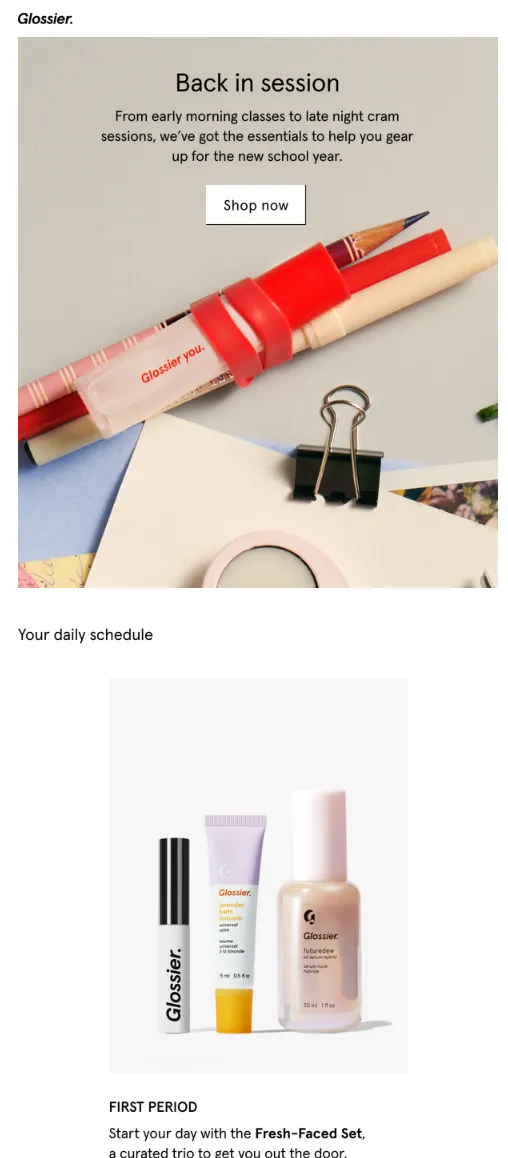
Glossier keeps this email really simple, but in a smart way. Instead of just listing products and discounts, they build the whole email around your school day, so it feels like they’re actually talking to you and your routine.
They start with “Back in Session” and say: “From early morning classes to late night cram sessions, we’ve got the essentials to help you gear up for the new school year.” It instantly feels relatable because you can picture your own school day in it.
Then they guide you through your day, step by step:
First period: You start your morning with the Fresh Faced Set. It’s basically your quick morning routine, something to help you get ready fast and feel fresh before class. It feels like they’re saying, “this is all you need to start your day right.” Then you can tap Shop Now if you want to grab it.
Second period: Between classes, they show you the Glossier You Rollerball. This is your quick refresh during the day, something small you can easily carry and use anytime you need it. It feels practical, like something you’d actually reach for when you’re busy running around school. Again, there’s a Shop Now button if you want it.
Third period: At the end of the day, they slow things down with the Body Hero Duo. This part feels more like self-care. After a long day of classes, it’s about relaxing and taking care of yourself before you rest.
This email works because it follows your real life. It doesn’t feel like a sales pitch, it feels like someone is simply walking you through your day and showing you what fits into each moment. It’s easy to understand, easy to imagine, and that’s what makes it effective.
Outdoor Voices - Create Guides

Outdoor Voices does some really smart things with their email campaigns and ads. Take a look at one of their recent email campaigns.
- The products are in full-display, with a well-made moving set of images (right inside the email -- no need to click “next”.
- Aimed at a slightly older audience, the image that Outdoor voices uses gets right to the point.
- The headline uses a language the target audience recognizes and uses -- a lot.
- Even the subject line is intended to make it seem like it’s coming from a friend (and not a brand).
Why it's a good example: put the carousel inside the email instead of behind a click. Every extra click is a drop-off, and back-to-school inboxes are crowded.
Get loads of inspiration and an almost unending list of creative ad campaigns and email campaigns on Panoramata. Further, create your own email marketing calendar for Back-to-school campaigns.
Prep up for your own campaigns, watch what other eCommerce businesses do for marketing, deep dive into insights for each campaign, and more.
Back to School campaigns are all the rage now, and there’s a good reason for it.
A Simple Back-to-School Email Calendar
Now that you’ve figured out who you’re targeting, when to start, and what type of content to send, you can turn those ideas into a simple calendar.
4–6 Weeks Before: Start the Conversation
Start your campaign before customers are ready to make their final purchases.
At this stage, focus on getting people thinking about the new school year rather than immediately pushing a big promotion.
You could send:
- A back-to-school announcement
- A preparation checklist
- A new collection preview
- Helpful planning tips
- “What you'll need this year” content
This is also a good time to introduce products that customers may want to start considering early.
For example, a tech brand could showcase laptops or study accessories, while a clothing brand could introduce its new-season collection.
The goal: Get your brand on their radar early.
2–3 Weeks Before: Help Them Shop
Now that the first day is getting closer, customers are likely moving from planning to actually shopping.
This is where your emails can become more product-focused.
Try sending:
- Back-to-school essentials
- Shopping guides
- Product recommendations
- New arrivals
- Bundles
- Early-bird promotions
Instead of sending your entire catalog, organize products around a specific need.
For example:
- First-Day Essentials
- Dorm Room Must-Haves
- Teacher Classroom Picks
- Study Setup
- Lunchbox Essentials
This makes your email easier to browse and gives customers a reason to click.
The goal: Help customers figure out what they need and make shopping easier.
1 Week Before: Create Some Urgency
At this point, the first day of school is getting close.
Your messaging can become more direct and action-focused.
Think:
- School starts next week
- Don't forget these essentials
- Last chance to save
If you're offering free or express shipping, this is a particularly useful time to highlight the order deadline.
Instead of simply saying: Order soon!
Give customers a specific date: Order by August 25 for the best chance of receiving your order before school starts.
A real deadline gives people a reason to act without relying on fake urgency.
The goal: Encourage customers who have been putting off their shopping to take action.
First Week of School: Shift the Message
Once school actually starts, you don't necessarily need to keep sending “BACK TO SCHOOL SALE” emails.
The customer's needs have changed.
Now they're settling into new schedules and routines, so your content can shift with them.
You could send:
- Study tips
- Easy lunch ideas
- Organization advice
- Classroom resources
- Productivity tips
- Self-care ideas
This is also a good opportunity for businesses that don't traditionally sell school products. Think about how your product or service can help customers adjust to their new routine.
The goal: Stay useful and relevant after the shopping rush.
After School Starts: Keep the Conversation Going
Your back-to-school campaign doesn't have to end on the first day.
A follow-up email can help you stay connected with customers while the new routine is still settling in.
Try something simple like:
“How's the new school routine going?”
From there, you could share helpful resources, related products, recommendations, or content that makes the next few weeks easier.
This can also be a good time to introduce products that customers may not have needed before the first day but might want once they're settled into their routine.
The goal: Turn a seasonal campaign into an ongoing relationship.
Here's the whole campaign at a glance:
Let's be clear: you don’t have to send every email or use every idea in this guide.
Choose what makes the most sense for your audience, products, and timeline. The important thing is to plan the sequence rather than treat back-to-school as one single promotional moment.
Back-to-school email marketing doesn’t have to mean sending a constant stream of promotions. A simple calendar can help you meet customers at the right moment, from planning early and starting their shopping to making those last-minute purchases and settling into a new school routine.
If you’re having a hard time figuring out what to send or when to send it, looking at what other brands are doing can be a helpful place to start. Tools like Panoramata make that research easier, so you can spend less time digging through competitor campaigns and more time planning your own.
Start early, give each email a clear purpose, and adjust your messaging as the season moves along. The goal isn’t to send more emails, it’s to send the right email at the right time.
FAQ
When should back to school email campaigns start?
Six to eight weeks before the first day of school in your main market. In 2026, 62% of US shoppers had already started back-to-school buying by early July, and 54% used June sales events like Prime Day for school purchases. If your first send lands in August, most of your market has already begun.
What should go in a back to school email calendar?
Four sends, in this order: an inspiration or ideas email, a category or gift-guide email, an offer email, and a last-chance email tied to your shipping cutoff. Add a fifth "replenish" send in late September — 47% of shoppers say they buy only the essentials for day one and restock through the year.
Does back to school marketing work if I do not sell school supplies?
Yes, and the spending data says it works better. School supplies is the smallest of the four K-12 categories at $146.45 per family. Electronics is $293.11, clothing and accessories $250.29, shoes $174.01. Apparel, footwear, electronics, home and food brands all have a bigger share of this season than stationery does.
How much do families spend on back to school?
In 2026, families with K-12 students plan to spend an average of $863.86, a record $43.3 billion in total. College students and their families plan to spend an average of $1,437.79, or $103.5 billion — the first time the college figure has passed $100 billion. Source: NRF and Prosper Insights & Analytics, survey of 7,677 consumers fielded 1–8 July 2026.
What are good back to school email subject lines?
The three campaigns in this article do three different things. Outdoor Voices writes the subject line so it reads like it came from a friend rather than a brand. Casper uses "still going" to imply the offer is about to end without claiming a fake deadline. The Sill states the offer flat — 15% off. Curiosity, soft urgency, or plain clarity. Pick one per send rather than stacking all three.
Should back to school emails always include a discount?
No. 46% of shoppers who have not finished buying say they are waiting for the best deals, which means a discount-only calendar trains them to keep waiting. Lead with ideas and category guidance in the early sends and hold the offer for the middle of the window.


